


BUILDING CONSTRUCTIONS, BUILDINGS AND STRUCTURES
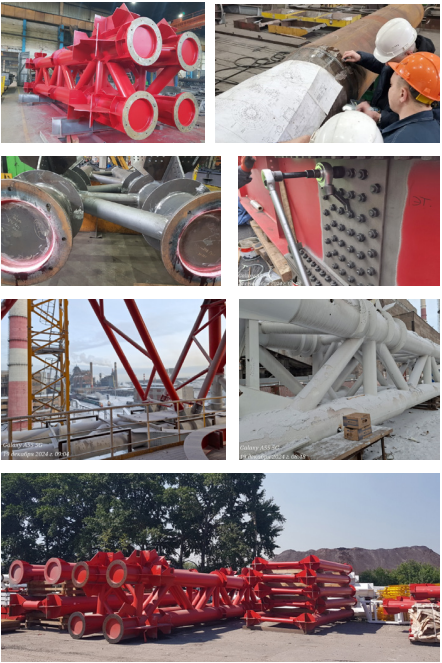
Introduction. The article presents data on scientific and technical support (STS) for the manufacture and installation of the above-ground part of a 150 m high extraction tower, which is a supporting structure for gas cleaning at a sintering plant in Novokuznetsk. STS and monitoring were carried out by employees of the Research Institute of Building Constructions named after V.A. Koucherenko from January 2024 to May 2025. The most stressed elements of the structure, located at elevations +1.700 and +17.000, were equipped with mechanical strain gauges and devices; their readings provided an overview of the stress state of the entire structure. In addition, geodetic data on the strain state of the structure acquired during construction and provided by the Customer were analyzed.
Aim. To perform scientific and technical support and monitoring using a method developed by the Research Institute of Building Constructions named after V.A. Koucherenko for observing the condition of individual structures and critical components of the tower, supporting structures of the sinter plant gas cleaning system, and for preventing collisions during enlargement.
Materials and methods. Metal structures were manufactured using non-destructive testing methods including visual inspection, ultrasonic testing, and capillary (color) flaw detection. The cross-sections of the tower elements are round electric-welded straight-seam pipes C355 (State Standard 27772-2021) of various diameters, welded flanges made of thick-sheet steel C390 (State Standard 27772-2021), and mounting nodes on bolted joints.
Results. The monitoring of the tower supporting the steel structures of the gas cleaning elements at the EVRAZ metallurgical plant, carried out during the STS manufacturing and installation process, ensures the mechanical safety of the structure by controlling the stresses in the most loaded structural elements and by analyzing their movements and deformations.
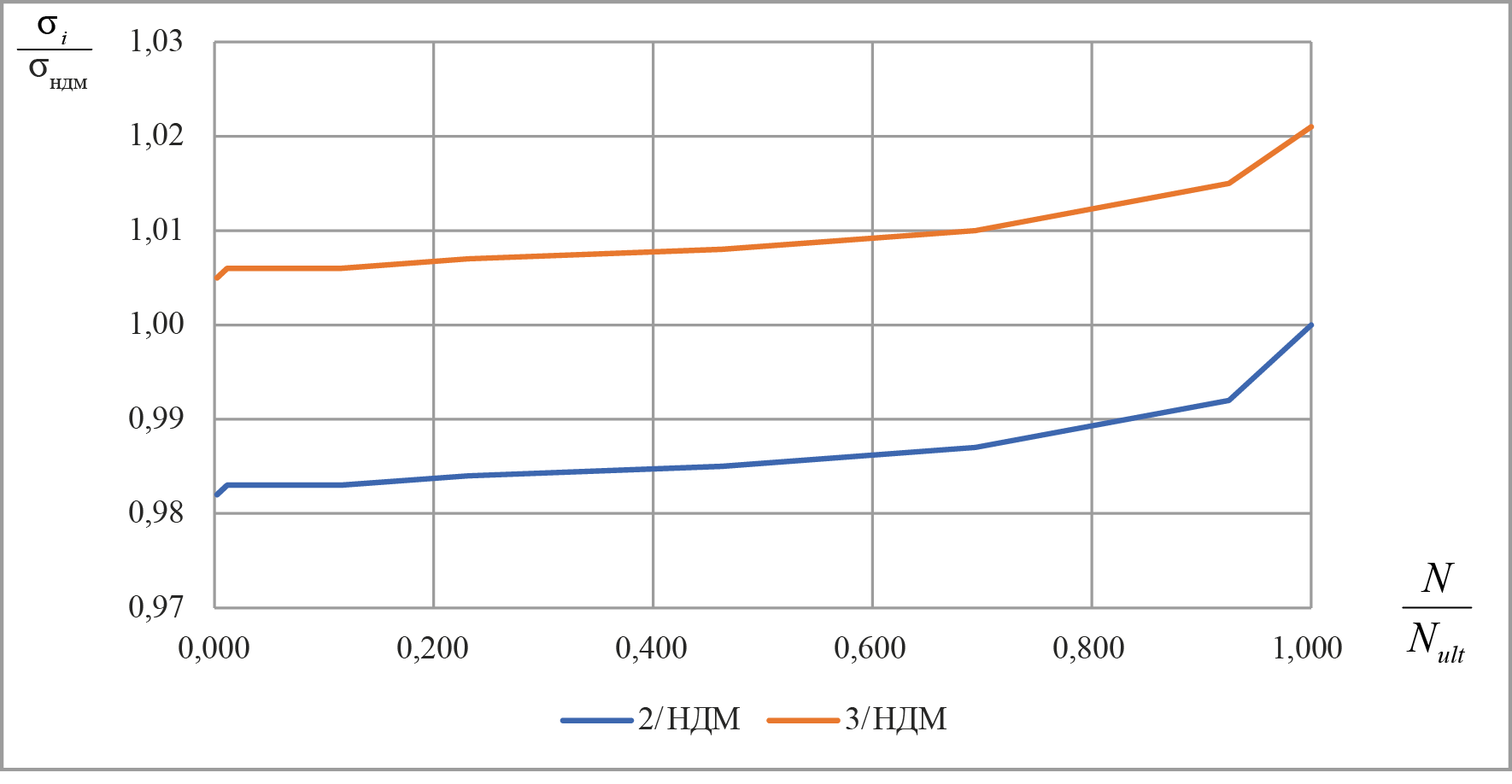
Introduction. The article discusses the SP 63.13330.2018 methodology for calculating inclined sections under the action of transverse forces, taking into account the influence of compressive longitudinal forces. The precise and simplified methods for determining average stresses, as well as the method for calculating the coefficient of the longitudinal force effect on the strength of inclined sections are analyzed. Moreover, a comparative analysis of this coefficient determined using simplified and precise methods is carried out. The shown individual shortcomings of the standard method in the area of high compressive stresses indicate the need for further research.
Aim. To consider the features of the standard methodology for calculating the strength of inclined sections for reinforced concrete elements under the action of transverse and longitudinal forces.
Materials and methods. Theoretical studies are carried out based on the results of the numerical analysis of SP 63.13330.2018 methods for calculating the strength of inclined sections.
Results. The present work includes numerical theoretical studies on a comparative analysis of calculation methods given in the standards for different reinforcement contents of concrete elements. The results demonstrate that at high stress levels and reinforcement content, standard methods may show significant discrepancies affecting the correctness of the strength assessment for inclined sections under longitudinal forces. In this regard, the need for research on this issue, including elements made of high-strength concrete, is indicated.
Conclusions. The performed analysis of standard methods for calculating the strength of inclined sections, taking into account the effect of longitudinal forces, shows that significant discrepancies in the strength of inclined sections can be observed in a number of cases with a high level of compression. The possibility of brittle failure under the action of transverse forces necessitate further research on this issue, including for high-strength concrete structures, and further development of the calculation method for inclined sections taking into account longitudinal forces.
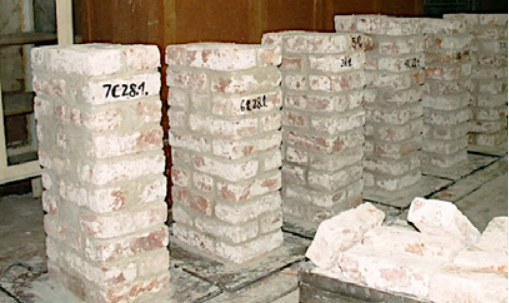
Introduction. Brick masonry of historical buildings has a number of features compared to masonry made of contemporary materials. This applies to both strength and strain characteristics. Incorrectly assessed strain of masonry walls, pillars, etc. can lead to a faulty estimate of the magnitude of forces redistributed between them.
Aim. To obtain experimental data on the strength and strain of masonry made of historical brick, including that constructed with lime mortar; to use the obtained results for strength and strain studies of masonry reinforced by mortar injection, including in combination with indirect reinforcement, in areas with repairs during the restoration of historical masonry with contemporary one, as well as in locations of combined action of backfill and facing layers.
Materials and methods. Compression tests are carried out on historical brick samples in the form of pillars and walls with mortars of various strengths, including lime mortar. Samples with the inner layer (backfill) different in strength and strain from the facing layers are additionally tested for local compression and central compression with a uniformly distributed load.
Results. The main strength and strain characteristics of masonry made of historical brick, including those with lime mortar, are obtained. The research results are used in the development of regulatory documents on masonry structures, as well as recommendations and projects for strengthening the masonry structures of historical buildings.
Conclusions. The elastic characteristics of masonry with lime and complex lime-admixed mortars are below the standard values. The transverse expansion coefficients of masonry (Poisson’s ratio) for various vertical stresses were obtained to be included in regulatory documents. The compressive strength of the masonry significantly exceeds the values specified in the standards, which is largely due to the quality of performed work as well as specifics of historical bricks masonry.
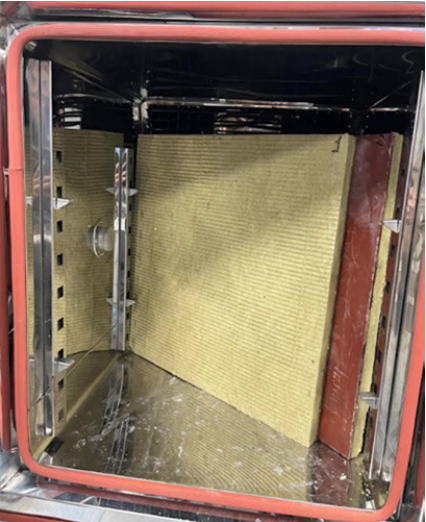
Introduction. The efficiency of fire protection systems for steel structures is determined by their ability to maintain their properties when exposed to external factors, including climatic loads. Natural tests of coating durability require a long time, making accelerated aging methods relevant. The article examines the features of experimental determination of the guaranteed or predicted service life for a structural fire protection based on mineral wool slabs for metal building structures, depending on operating conditions.
Aim. To study the efficiency of structural fire protection based on mineral wool slabs during climatic aging under UKhL2 and UKhL3 operating conditions according to State Standard 15150-69 using the example of a contemporary coating.
Materials and methods. The performed work includes cyclic artificial aging of a structural fire-protective coating for 5, 10, 15, 20, and 25 years according to the methodology of State Standard R 71618-2024. The resistance to climatic factors and maintenance of fire-protective properties during operation are assessed using three methods: measurement of thermal conductivity according to State Standard 7076-99, thermal analysis according to State Standard R 53293-2009, and assessment of fire protection efficiency according to State Standard R 53295-2009. The study uses 600 × 600 × 5 mm sheets of 08kp and 08ps steel according to State Standard 16523-97 and State Standard 9045-93 with applied ET-METALL structural system, including 30 mm EURO-LIT mineral wool thermal insulation slabs and 2 mm PLAZAS heat-resistant adhesive composition.
Results. The fire protection efficiency decreasing with an increase in the number of artificial aging cycles is established 16.7 % lower than the control sample at 125 cycles (25 years).
Conclusions. The predicted service life of the ET-METALL structural system outdoors under a canopy (UKhL2) and inside buildings with natural ventilation (UKhL3) is at least 25 years.
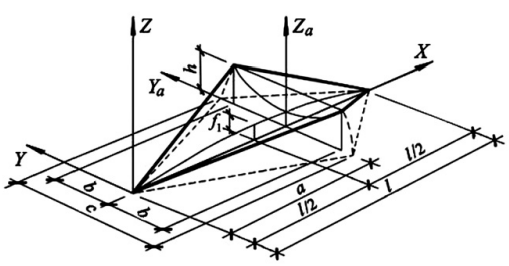
Introduction. The present article considers a research into the spatial structures of buildings with load-bearing precast reinforced concrete elements manufactured using the technology of flexible mould processing (FMP).
Aim. To develop the fundamentals of the regulatory framework for the design of buildings with FMP elements.
Materials and methods. Computational and theoretical studies of design concepts for domed and vaulted buildings using precast FMP elements are carried out. Data on the stress-strain state of various-size building structures under various loading conditions are obtained.
Results. The results of computational and theoretical studies are analyzed to develop recommendations for the design and reinforcement of elements and units. Proposals for standardizing the parameters of building structural elements are developed for inclusion in regulatory documentation. Proposals are made to introduce a new section on the spatial building structures made of precast FMP elements into SP 387.1325800.2018.
Conclusions. The developed recommendations are aimed at increasing the efficiency of spatial design concepts for building structures.
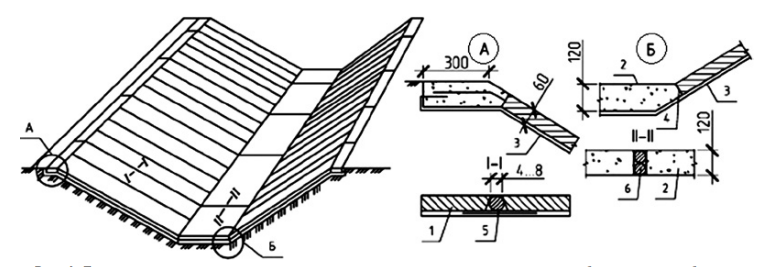
Introduction. After studying the research materials presented in the reviewed articles, the Research Institute of Concrete and Reinforced Concrete named after A.A. Gvozdev have completed the work on updating the State Standard 22930-87 interstate standard “Prestressed reinforced concrete slabs for lining irrigation canals of reclamation systems. Specifications”.
Aim. To inform the specialists in the field of land reclamation construction about the revision of State Standard 22930-87 provisions regarding the technical conditions for the manufacture of prestressed reinforced concrete slabs for lining irrigation canals of reclamation systems due to the updated regulatory framework for the design and manufacture of reinforced concrete products.
Results. The revision of State Standard 22930-87 addressed the following issues: the structure and provisions of the standard were adjusted; the requirements to the rules for ensuring the uniformity of measurements in the Russian Federation were clarified. The requirements for testing the slabs are presented; control loads for strength and cracking resistance testing of slabs are specified. The urgency of updating the State Standard 22930-87 interstate standard for the industry is substantiated. The objectives and key changes introduced in the new edition of the standard (State Standard 22930-2025) are described in detail. Updated requirements for concrete, including the strength class, as well as frost and water resistance grades, accuracy of slab geometric parameters, acceptance rules, and inspection methods are provided. Particular attention is paid to the compliance of fillers to State Standard 8267-93 and State Standard 8736-2014 for ensuring the concrete resistance to the alkali-silica reaction and guarantying the durability of structures.
Conclusions. The updated State Standard 22930 will facilitate the high-quality design and manufacture of reliable and durable prestressed reinforced concrete slabs for lining irrigation canals of drainage systems.
FOUNDATIONS, UNDERGROUND STRUCTURES
Introduction. Temperature sensor systems installed in wells at various depths are widely used to monitor temperature conditions in permafrost soils. In this case, sensors are typically located inside special tubes protecting the equipment from mechanical and chemical impacts. However, design features of these tubes, such as material and diameter, can affect the efficiency of heat transfer from soil to the sensor and thus the accuracy of measurements. Moreover, the issue of thermal insulation for the above-ground part of the protective tube is relevant to eliminate the influence of air temperature on the readings of temperature sensors.
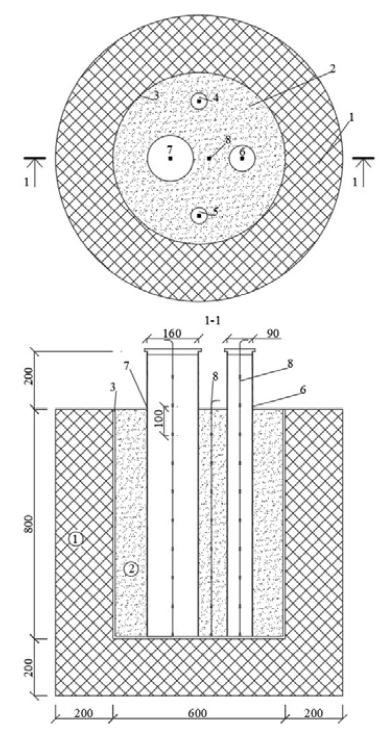
Aim. To determine the reliability of soil temperature values by depth depending on the thermometric well design; to develop the most optimal design of a thermometric well.
Materials and methods. The method involves analyzing archival survey and design documentation, as well as regulatory and other technical sources, conducting soil container experiments, and developing recommendations for taking into account the design parameters of thermometric wells when measuring the temperature of permafrost soils.
Results. The optimal design of a thermometric well is determined in experimental studies. Recommendations for amendments to SP 25.13330.2020 and State Standard 25358-2020 are provided.
Conclusions. For routine monitoring, protective PVC or steel tubes with a diameter of 57 mm should be used. The studies of the exact soil temperature in the seasonal thaw layer should consider the error caused by steel; otherwise, a PVC tube should be used. The head of the tube must be reliably thermally insulated.
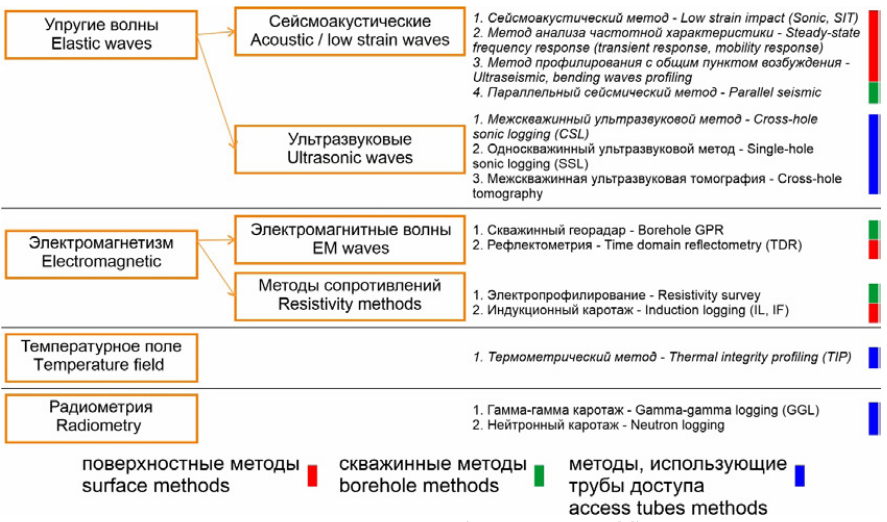
Introduction. Highly intensive work on the construction of pile foundations requires a well-established system of testing and quality control. The main non-destructive methods of technical geophysics used to monitor the integrity of concrete and depth of piles is sufficiently well studied from both a scientific and practical point of view. The transition to a parametric standardization system established a number of provisions for the application of these methods in national standards. Low strain impact testing methods and crosshole sonic logging received their own State Standard R 71039 and State Standard R 72171 standards; thermal integrity profiling was included in broad-scope State Standard R 71733. The simultaneous release of several regulatory documents will expand the field of geophysical activity due to the ability of performing complex work.
Aim. To inform test engineers, designers, and employees of supervisory organizations about the current state of regulatory framework on non-destructive testing of pile foundations.
Materials and methods. The paper describes a set of geophysical methods used to monitor the integrity and length of pile foundations. The methods developed sufficiently for including in regulatory documents are indicated.
Results. The performed work systematizes the information on the current state of regulatory framework on the use of geophysical methods for non-destructive testing of piles. The content of standards for low strain impact, crosshole sonic logging, and thermal integrity profiling testing is used to demonstrate possible directions for regulating methods of technical geophysics.
Conclusions. The main geophysical methods used in non-destructive testing of pile foundations have now received the necessary regulation in national standards. The possibility of accumulating information on the capabilities and limitations of auxiliary examination methods is provided. The prospects for developing regulatory frameworks lie in the further harmonization of standards with current codes and State Standards, including the analysis of empirical data to correct documents during future revisions.
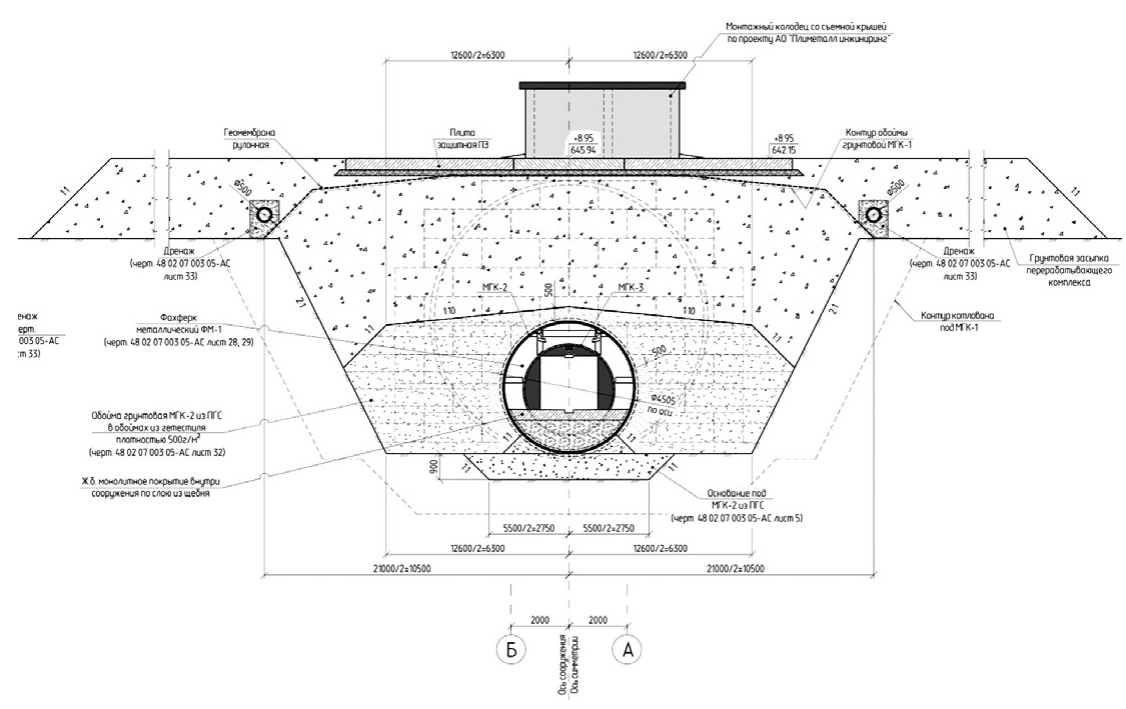
Introduction. Conventional vibration compaction for backfilling trenches and foundation cavities in cramped conditions often results in uneven settlement, which is critical for large pipes, especially in collapsible and swelling soils.
Aim. To evaluate the applicability of controlled low strength material (CLSM) as an alternative to conventional backfills with a focus on controlled strength properties, uniformity of filling, and possibility of re-excavation.
Materials and methods. The present paper reviews laboratory and pilot-scale data from Germany, China, and the USA, as well as initial Russian implementations. The mixtures based on local clay and sandy soils with the addition of cement, fly ash, bentonite, and modifiers are considered. The effects of water-cement ratio, granulometry, and cement fraction (≈6–12 %) on the flow rate (spread) and compressive strength of mixtures is assessed.
Results. CLSM ensures high uniformity of filling and reduces the need for vibration compaction. Mixtures with 12 % cement show the greatest sensitivity of the flow rate to small increases in water content. The achieved compressive strength of about 0.5–2.0 MPa meets operational requirements while maintaining re-excavation for mixtures with reduced binder. The practice of Germany, China, the USA, and Russian Federation confirms the technological versatility for reconstruction and problematic soil conditions.
Conclusions. CLSM technology reduces the risk of settlement and vibration, ensuring self-compaction and re-excavation of the soil mass. The main barrier is the lack of an appropriate regulatory framework and standardization.
BUILDING MATERIALS AND PRODUCTS
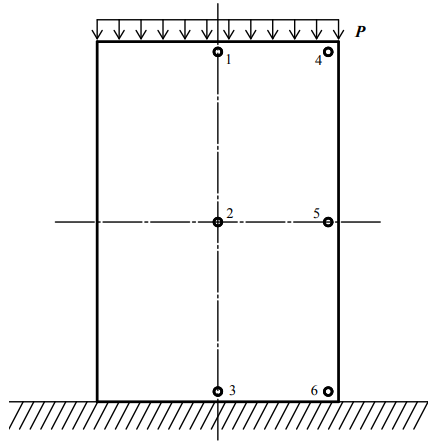
Introduction. Wave propagation of stress and strain in wood as a structural material have their own characteristics. The geometric shape of wooden structural elements as a boundary between physical media, the structural shape of nodes and joints typically made of steel elements, adhesive layers, as well as layers of glued wood form complex boundary conditions for the development of a stress-strain state.
Aim. To substantiate a model of stress wave reflection from the boundary of a medium in a wooden sample with qualitative and quantitative assessments of the change in stress over time and along the sample length. The strain model of wood as a natural polymer can be used to substantiate the long-term strength of wood and wooden structures based on the kinetic strength theory.
Materials and methods. The studies of G. Kolsky, R.M. Davis, and Yu.N. Rabotnov are analyzed for substantiating the proposed model of wave processes in wood and wooden structures. Moreover, the hypothesis about the effect of wave strain propagation on the long-term strength is substantiated. The effects of stress wave reflection from the boundaries of an assumed elastic bounded medium are demonstrated in the numerical experiment. Two hypotheses are proposed. The first one assumes using the physical properties of material and geometric dimensions of the structural element. In addition, the magnitude and duration of the external load are used to determine a so-called “depth threshold,” below which the full wave effect of stress propagation within the sample begins to manifest itself. The second hypothesis considers a toroidal body with a tending to infinity length many times greater than its diameter as a cylinder of infinite length simulating an infinite medium.
Results. The stress waves propagate in the volume of the loaded sample at rest, gradually attenuating to a value of 27 MPa equivalent stress according to von Mises. The stresses on the surface where the external load is applied stabilize faster; the wave processes of stress change are characterized by a small amplitude.
Conclusions. The performed numerical and field experiments revealed a pattern confirming the previously formulated hypothesis of a significant excess in the stress wave value over the stress value for the loaded element at rest. When the sample is compressed, the reflected stress oscillates at an amplitude established relative to the value of the stress at rest.
LIFECYCLE MANAGEMENT OF CONSTRUCTION PROJECTS
Introduction. The paper examines the application of unmanned aerial vehicles (UAVs) in construction, emphasizing their use for geodetic surveys, site monitoring, and construction supervision.
Aim. To analyze contemporary UAV applications in design and construction, as well to assess their impact on the accuracy, cost, and duration of construction period. To achieve this goal, we set the following objectives: to classify existing UAV application practices; to identify their key advantages and limitations; to determine the most promising areas of their use based on an analysis of specific cases.
Materials and methods. The study is based on the analysis and systematization of comments on the draft amendments to SP 126.13330.2017. The methodology of the study includes collecting proposals from the explanatory note and discussion materials with their classification according to target aspects including document structure, terminology, and technical requirements with subsequent generalization. The study yielded a summary table that clearly presents the analyzed comments and recommendations to form the basis for integrating UAV technology into the regulatory framework.
Results. The importance of UAVs for improving safety at construction sites, construction quality, and efficiency of work execution is substantiated. The article considers real-world examples of using UAVs to monitor roads, high-rise buildings, and historical sites, as well as highlights the role of new technologies in monitoring industrial facilities.
Conclusions. The presented results demonstrate the successful implementation of UAVs in construction processes, as well as the need for further improvements of the regulatory framework to fully utilize their potential.

ISSN 2782-3938 (Online)


